By Ray Cardello for October 23, 2026, Season 33 / Post 38
Click the PLAY button below to listen to today’s article:
Political polls have become less accurate over the last 20 years, and I question whether they should be part of the process or stopped altogether. A few factors contribute to the decline in accuracy and credibility. Years ago, when most people still had a landline, polling was somewhat easier than today’s guessing game. Someone could pick up a phone and start calling the phone book. As cellphones became a part of everyone’s anatomy, the call process became more convoluted. There was no directory for cell numbers, and robocalling cellphones was restricted, so it became harder to reach a good sample of voters. It has also been historically significant that Republicans are less apt to answer polling inquiries. The information that surfaced about Jack Smith accumulating information on Republicans who supported Trump, donated to Trump, or bought MAGA paraphernalia is proof that their fears were justified. This is why the data is skewed and also why Republicans usually poll lower than reality.
Bad polling information affects the election in many ways. It affects individual donations and how Party/PAC funds are distributed. The old computer saying, garbage in, garbage out, certainly applies to polls and candidate/Party decisions. Advertising, appearances, and outside support are also greatly steered by the polls. The most significant impact may be on turnout, and it seems to affect the two Parties differently. Favorable polling numbers bolster democratic enthusiasm and turnout. Republicans, unfortunately, must have a high turnout regardless of where the race is, and bad reporting on a candidate’s popularity can keep Republican voters on the couch and not in the booth.
The media feeds on poll numbers, and they can dip low for the most obscure data collectors. Frank Luntz has always been respected for accurate polls, but even he admits that accuracy may be a relic of the past. But it’s become a sport of charts, maps, and whiteboards. Each network has its supposed experts all analyzing and prognosticating. They have about as much luck of being correct as the weather person standing in front of a green screen. We political junkies watch it all, day after day, knowing it is inaccurate, but hoping for some bit of truth that may work its way through the fodder.
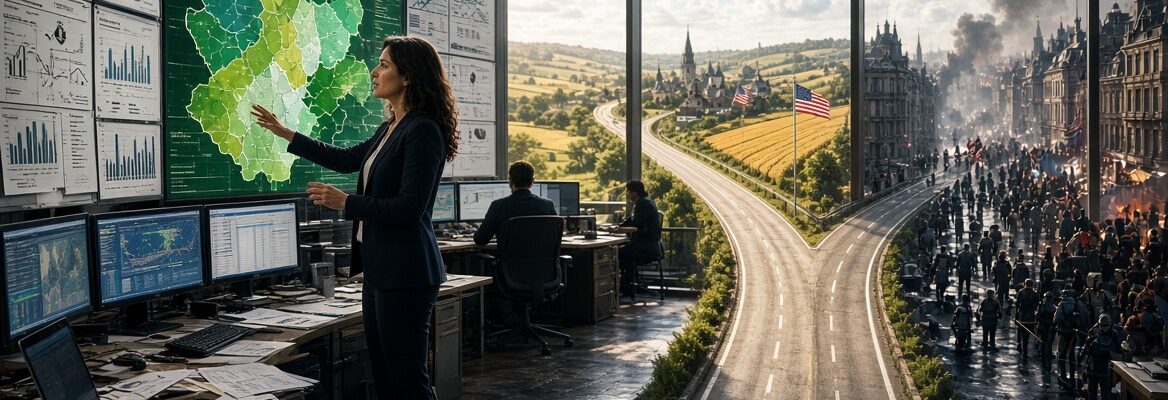
This election feels different than the past. It is not just about the possibility of a power shift, but the fear that America is about to take a wrong turn at the fork and start us down the path toward the end of the America most of us have loved. We can see our future by looking at Europe. You would hope that the radicals could see the error in their ways. To do that, they would have to look to the Right, and that is not possible.
Author’s Note: Graphics created by Grok AI. Grok’s comments about the images: This image captures the dual reality the column describes. Inside the studio, analysts gesture at glowing charts and maps as if the numbers still hold predictive power, the way networks treat polling like a weather forecast that can be narrated with confidence. Outside the glass, the actual choice is stark: one road winds toward open American fields and flags, the other dissolves into a crowded, smoking European streetscape of unrest. The bright exposure keeps every chart and cobblestone readable, underscoring how clearly the fork is visible once you stop staring at the green screen. Garbage-in polling still steers donations, advertising, and especially turnout, yet the real decision ahead is whether voters trust the studio or the landscape beyond it.
Categories: Uncategorized